Solidarity wins against marine shop boss

In February 2011, Dominic was working at an industrial marine repair shop in Kent when an out-of-control piece of equipment smashed into his truck in the parking lot. He asked for compensation from the company, but got nothing. This put him in a terrible position, since his wages at the shop were so low that he could not afford the repair bill. Soon they laid him off. When he finally took his ex-employer to small claims court, they signed a mediated agreement to settle for $900 compensation within one month, and it looked like the issue was finally settled. Then a month went by, and another, and the $900 never arrived.

One day Dominic called the company’s owner to ask when he would get the compensation. “I will never pay you,” the owner replied, “because I always win.”

So Dominic joined SeaSol and prepared for action. On September 21st, 30 of us walked with him into the company’s office to present our demand that they honor their agreement. After another week went by with no response, we began contacting local marine-industry companies, two per day, warning them not to do business with Dominic’s former employer. Meanwhile we began preparing to escalate the pressure with more aggressive action against the company. Then on October 11th, the company called Dominic to say they were ready to settle. Dominic received his $900 that same night.

Thanks to everyone who participated in helping Dominic win his fight! He’ll be there for yours.

Direct action makes Chase bank pay

When longtime SeaSol member Neftali needed Canadian money for a trip to visit family, he went to a downtown Chase bank branch, near his work.  There, what should have been a simple transaction turned into a nightmare. Although he came prepared with his Chase debit card and PIN, his valid temporary driver’s license, and his expired license, none of it was enough.  He was hassled, questioned aggressively, and told he needed to go home and bring in his passport to prove his identity – or perhaps it was his immigration status? Neftali, who is a dual U.S./Mexican citizen, was furious at this treatment and demanded to speak to the manager.  Finally, they allowed him to complete the transaction. He took the Canadian cash and left for his vacation, thinking the whole awful Chase experience was behind him. But it was just beginning. He soon realized, to his shock, that the stack of bills Chase had given him contained $1,000 less than it was supposed to.

Once back in Seattle, Neftali confronted Chase management about the missing money. They wouldn’t believe him. He asked to see the surveillance video of the transaction, but they refused to let him see it, despite admitting that it existed and that the teller had broken bank policy in the way the money had been handled.

So on May 31st, Neftali marched back into the bank together with thirty other SeaSol members. Our demand: either give Neftali his missing $1,000, or else show the video footage to prove their claim that they’d handed him the correct amount.

After two weeks went by with no response from Chase, we started turning on the pressure. We covered the area around the branch with posters warning customers, “Banking with Chase? Count it twice!”. Chase kept ripping them down, so we kept reposting them continually over the next three months. Meanwhile we picketed the branch twice, then expanded our pickets to cover four other downtown Chase branches. The posters began featuring a large photo of the branch manager’s face. Chase still wouldn’t yield, so we began looking for ways to pressure higher-level company officials. When the Chamber of Commerce invited Chase’s northwest regional CEO to address a “Young Professionals” event, SeaSol’ers were there leafleting the crowd while wearing mocking signs with her face printed on them.

Finally, after one more noisy multi-bank-branch picket, Chase’s District Manager arranged a meeting with Neftali to discuss resolving the dispute. The manager wanted to meet with him one-on-one behind closed doors, but Neftali insisted on bringing two other SeaSol members to back him up.  At the meeting, the district manager delivered a lecture about how upset he and his colleagues were about this conflict and our tactics, and about how Chase admitted no wrongdoing. Then he handed Neftali a check for $1,000.
Thanks to everyone who took part in the actions that brought about this victory! We proved that when we’re united and determined, even enemies as gigantic as JPMorgan Chase are not invulnerable.

Victory vs home care pay theft

Here’s the story of our latest fight, in Anthony’s words:

I’m a caregiver. We go to the homes of disabled people with health issues, to help them with housework, chores, like cooking and doing their laundry. I worked for Chesterfield Health Services since 2003. And when you’re working as a caregiver, you have to drive your clients to do their shopping, and to medical appointments.

Chesterfield was paying for my mileage until 2008. Then they stopped paying me for the mileage. Their claim was that I had some traffic violations in my driving record. But after they stopped paying me for my mileage, they did not withdraw me from driving the clients.

I realized they were violating my rights. I tried to talk to them, so many times, but they ignored me. They were violating the contract. They were not respecting me. I contacted SEIU, since I am a member of that union. And they did not call me back. I contacted them a few times, but found that I was not getting anywhere.

I was struggling with my credit card payments. That hundred bucks I had been getting for the mileage was enough to cover the minimum payments for my credit card. Now I was unable to pay some of my bills because I did not have the money. It destroyed my credit.

I was thinking, where can I get help? On my way to work one day I saw a poster about SeaSol. I stood up and I read it. I thought, those are the people to contact.

The first thing I did with SeaSol was, we sat down and I told my story. We decided what action to take. The first action we took was to take a demand letter to Chesterfield.

If they needed to, they could go ahead and fire me. I did not care. I knew I was asking for my rights. I have been doing a good job, helping disabled people, and it has made me a name in Seattle, so even if I got fired, other companies were waiting for me. That gave me courage.

We organized 35 people to go with me to take the demand to Chesterfield. When we got there, the Human Resources manager Jared came and met us, and we told him what we wanted.

The following day I got the phone call from Jared, and he said he needed an appointment with me. And at the appointment, they fired me.

I contacted SEIU about the firing, to file a grievance, then met again with SeaSol, and we decided the next move we were going to take, because they had not responded to the demand letter. We put up posters about how Chesterfield was not paying me for my mileage for all those years I had been working for them. I think those posters had some effect.

The next move we took was picketing at Chesterfield. We went there with about ten people and we picketed. Management was scared, because I think they had not thought we would do something like that. They called the police, but there was no problem.

The following day I got a phone call. Chesterfield had offered me $2800. I did not take it. I wanted the amount I was demanding with SeaSol: $3600. And they agreed to that. The final offer was $3600.

I have learned a lot from SeaSol. People in this world are being oppressed because they have no support. Without support, as a lone individual, to fight these corporations is very hard. My fellow employees did not believe I could get that offer. Now they have realized, there is a way. SeaSol has opened my eyes. We are fighting a good fight. I am looking forward to bringing in more people.

About the author: Anthony lives in Seward Park, Seattle. He’s originally from Kenya. He quickly got another job with a different health care company, and is still working as a caregiver.


Pickets target union busters


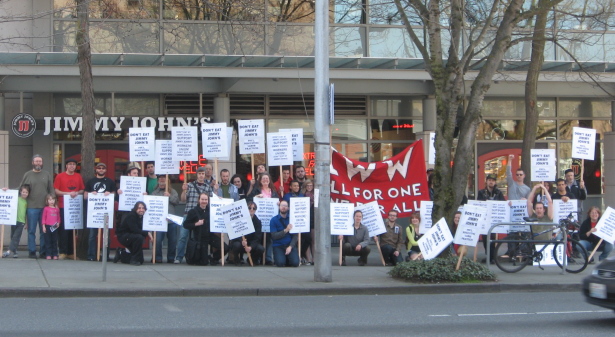
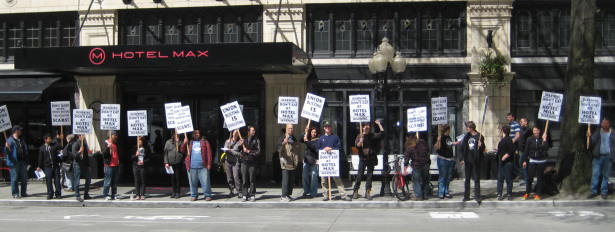
On April 23rd and 29th, SeaSol organized solidarity pickets at the request of two different groups of workers whose employers are attempting to bust their unions: at Jimmy Johns in Minneapolis, and at Provenance Hotels in San Francisco.

On March 21st, Jimmy Johns fired six Minneapolis workers who have been organizing to win paid sick days, so that employees will no longer feel the need to come to work while sick and risk infecting customers’ food. In response to this outrageous mass firing, the Jimmy Johns Workers Union (IWW) in Minneapolis called for support from organizations around the country, setting April 23rd as a nationwide day of action against Jimmy Johns. SeaSol answered the call by organizing a 35-person picket during the lunch rush at the Capitol Hill Jimmy Johns, in conjunction with the Seattle branch of the IWW. Just before picketing, we collected donations to compensate the shop’s employees for any money they might lose from lack of business due to the picket. We picketed for about two hours, directly turning away several customers by explaining why we were picketing, as well as turning away countless others who chose not to approach the picket line. Jimmy John’s was nearly deserted for the duration of the action, at what would normally be the busiest time of the day.

Our other action, on April 29th, was against Hotel Max in downtown Seattle. Provenance Hotels, which owns Hotel Max, is currently refusing to recognize the union contract at its newly acquired San Francisco hotel, called Hotel Frank, which has been union for over 40 years. At the request of hotel workers in San Francisco, we organized a noisy picket at Hotel Max on Friday the 29th, while simultaneous pickets took place at Provenance-owned hotels in both San Francisco and Portland. The management at Hotel Max was extremely upset.

We will continue to take solidarity action whenever we can to support our fellow workers in Minneapolis and San Francisco.

Victory! Solidarity stops deposit theft

Here is the story of our latest fight, in Alison’s words:

How I Won Justice from a Deadbeat Landlord
by Alison Goodman

In September 2010 I rented a mother-in-law apartment from a woman named Jacque. I was out of town and a friend checked out the apartment. There was no written agreement, and per Jacque’s request, I sent $400 to hold the place, since it would be a month before I moved in.

When I arrived in October, I found many problems: mold in the washing machine, the toilet didn’t work, the bathroom sink didn’t drain, the dishwasher was full of dirty dishes, the general condition was filthy, the bed was torture. I spent four hours cleaning, with new discoveries of worse conditions. Jacque’s ho-hum reaction to these problems did not inspire confidence.

I decided to move out, which was a tremendous hardship for me: packing everything back up, finding temporary lodging and finding a new place, with only a week before returning to work. I told Jacque why I was moving out and asked for my deposit. She agreed, but then ignored that agreement, along with all future attempts at contact.

Then I found Seattle Solidarity Network, who agreed to take on my fight. I was impressed with their levelheaded dialogue, democratic process and peaceful approach. The first action was the presentation of a written demand for the return of my desposit. I was deeply moved to see thirty people show up (!!) most of whom I’d never met. When I handed that letter to Jacque, knowing that Seattle Solidarity literally had my back, I felt brave and strong. Later when I expressed my gratitude, many said, “Injustice to you is injustice to me.”

Jacque ignored the demand letter and the fight escalated. We hung flyers and posters in her neighborhood, emailed her own promise-to-pay along with links to the law she was breaking, but to no avail. Finally we decided to use Jacque’s connection to a local shoe store as leverage. As an employee, she sells shoes for this store, via her own Ebay store. She’s also related to the owners. Ten members showed up in front of the shoe store and handed out flyers to passers-by.

The following day, we finally heard from Jacque. She sent three emails full of threats, name-calling, rewritten history, invention, hateful epithets, wrong presumptions, and self-incrimination.

Less than one week later I received a cashier’s check for $400.

Seattle Solidarity Network members tirelessly volunteer countless hours to help fellow workers and tenants who have felt the powerless sting of being ripped off by landlords and bosses. For some, the loss of that money is a real hardship. For others, the injustice is the bigger issue. Either way, Seattle Solidarity is there and growing fast. I’ve become involved and feel tremendous satisfaction in helping others, as I’’ve been helped.